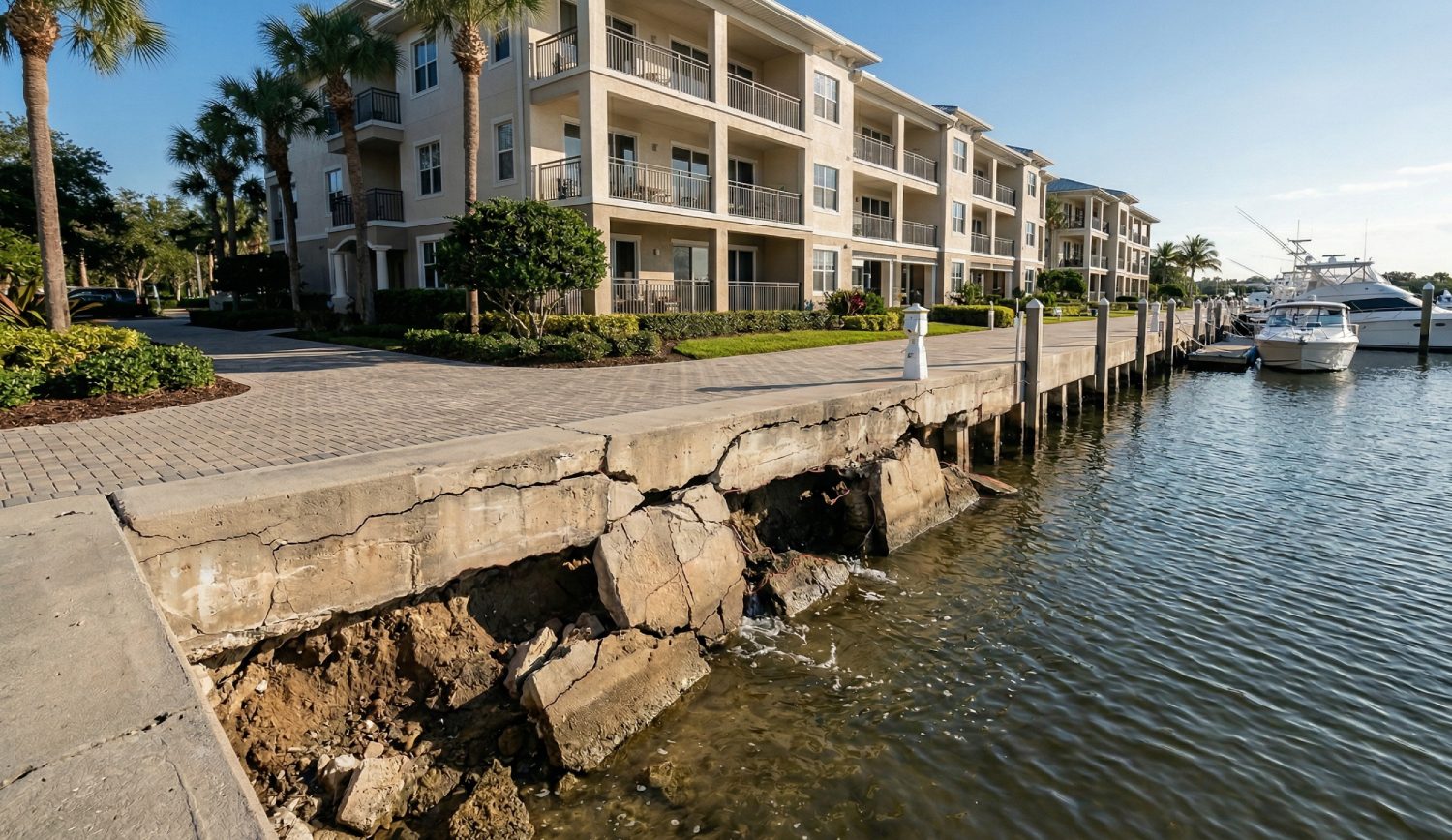
Seawall failure is rarely sudden. It builds for months or years before it becomes obvious, and by the time it is obvious, the cost of fixing it has usually multiplied several times over. The good news is that seawalls almost always show warning signs before they reach a critical point. The hard part is knowing what to look for.
Here are the five signs every waterfront property owner should be watching for.
1. Cracks in the vertical panels or cap
Visible cracks are one of the clearest indicators that something is wrong. That includes cracks in the vertical panels of the seawall and cracks in the cap that runs along the top. Cracks let water flow through the wall freely, which means soil can flow with it. Hairline cracks may seem minor, but they tend to widen quickly under tidal pressure and weather cycles.
2. Depressions or soft spots in the yard
If the ground within a few feet of the seawall starts forming low spots, soft patches, or shallow depressions, the soil behind the wall is moving. Most often it is being pulled through cracks or seams in the wall and carried out into the water with the tide. What you see in your yard is the visible result of erosion happening underground.
3. Water bubbling up from the ground
Water emerging from the soil near the seawall is a sign that hydrostatic pressure is no longer balanced. This often shows up during high tide or after heavy rain. Either water is being forced up from below, or the wall is no longer doing its job of separating the water side from the land side. In either case, the situation warrants a professional evaluation.
4. Small sinkholes along the wall
Small sinkholes, sometimes only a few inches across, can form along the base of the wall or a few feet inland. These are voids in the soil where material has eroded away. They are often the early stage of a larger collapse, and they tend to grow quickly once they appear.
5. Leaning or bowing
If a section of the seawall is visibly tilted toward the water, bowing outward, or no longer holding a true vertical line, the wall is under structural stress it was not designed to handle. Leaning is one of the later-stage warning signs. At that point, a repair conversation should already be happening.
Why catching it early matters
Seawall issues compound. A small crack today turns into a soil void next year, which turns into a leaning panel the year after, which can turn into full replacement. Replacement typically costs three to four times more than a well-timed repair. Repairs done early are also often eligible for longer warranties because they address a smaller, more contained problem.
If any of these signs are showing up on your property, it is worth getting a professional evaluation before the next storm season makes the decision for you.
How Ultramarine Solutions can help
Most seawall problems have more than one possible fix, and the right one depends on what is actually causing the failure. Ultramarine Solutions evaluates each wall in context: its age, materials, condition, surrounding soil, water exposure, and the underlying source of whatever symptoms have shown up. Depending on what we find, the right solution might be soil stabilization, cap repair, panel replacement, hydrostatic pressure relief, or a targeted intervention like SeamShield, which addresses soil loss and water infiltration through compromised seams and panel cracks.
The point is that there is rarely one answer. There is the right answer for your wall. We come out, evaluate, and walk you through the options. The on-site evaluation is no-cost.
Contact us to schedule an evaluation.