
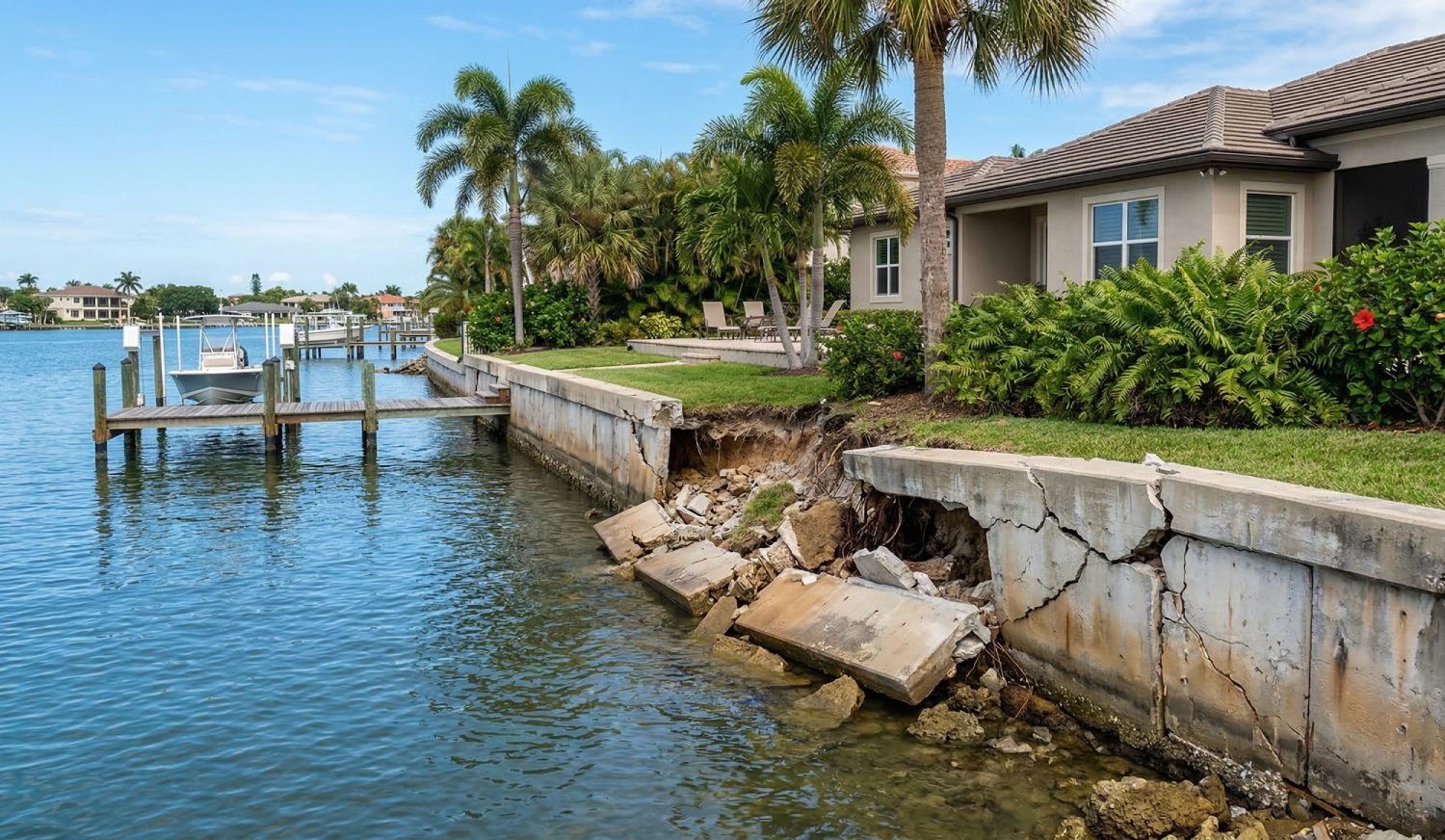
Seawalls do not usually fail because of one dramatic event. They fail because a handful of forces work against them, slowly and continuously, for decades. Most of those forces are invisible from above the waterline. The damage they cause shows up in cracks, depressions, and eventually structural failure.
Understanding how seawalls actually fail is the best way to protect one before it becomes a major repair.
The age problem
A significant portion of the seawalls protecting today’s waterfront properties were built more than fifty years ago, during the postwar boom that opened up coastal and canal-side communities across the country. Many were built quickly, to standards that would not be acceptable today, with materials that have since proven less durable than the engineering of the era assumed. Some older seawalls have lasted a century or more, but those are the exception. They tend to be the ones built to higher original standards or maintained consistently.
For everyone else, the question is not whether the wall will need attention. The question is when.
The environmental load
A seawall lives in one of the harshest environments any structure has to endure. On the water side, it faces tidal action, currents, boat wakes, and periodic storm surges. In saltwater environments, corrosion adds another constant pressure on materials and fasteners. Salt works its way into concrete, attacks steel reinforcement, and accelerates wear in ways that freshwater environments do not. Even in freshwater settings, freeze-thaw cycles, biological growth, and steady wave energy take their toll over time.
On the land side, the wall is dealing with a different set of stresses. Rainwater, irrigation runoff, and the steady hydrostatic pressure of saturated soil all push outward against the back of the wall. When that pressure has no way to escape, it builds and eventually finds the weakest point, usually a seam, a crack, or a worn fastener.
How the failure cascade actually works
Most seawall failures follow a predictable pattern. Water finds a small opening: a hairline crack, a separated seam, a corroded fastener. Once water can move freely through the wall, soil moves with it. Each tide cycle or water-level shift pulls a small amount of material out from behind the wall and deposits it in the waterway. Over time, that creates voids in the soil behind the wall.
Those voids are why depressions and small sinkholes show up in waterfront yards. They are also why the structural integrity of the wall begins to degrade. The wall was designed to retain solid soil, not to span hollow pockets. As the voids grow, the wall has to carry more load with less support, which leads to bowing, leaning, and eventually structural failure of the panels themselves.
The takeaway
Seawall failure is a chain reaction, and the chain almost always starts with something small and easily addressed. Catching a problem in the crack-and-seam stage is straightforward and relatively inexpensive. Catching it in the leaning-panel stage is a different conversation entirely.
The forces working against a seawall do not pause. The maintenance approach cannot either.
How Ultramarine Solutions can help
Ultramarine Solutions specializes in catching seawall problems at the stage where they can still be addressed without full reconstruction. Our team evaluates walls across a range of ages, materials, and environments, and identifies what is actually driving the deterioration. From there, we work with property owners to put a repair or maintenance plan in place that protects the wall and the property behind it for years to come.
If you have not had your seawall looked at recently, or you are starting to see early warning signs, schedule an evaluation. There is no cost, and you walk away with a clear picture of what is happening and what your options are.
Contact us to schedule an evaluation.